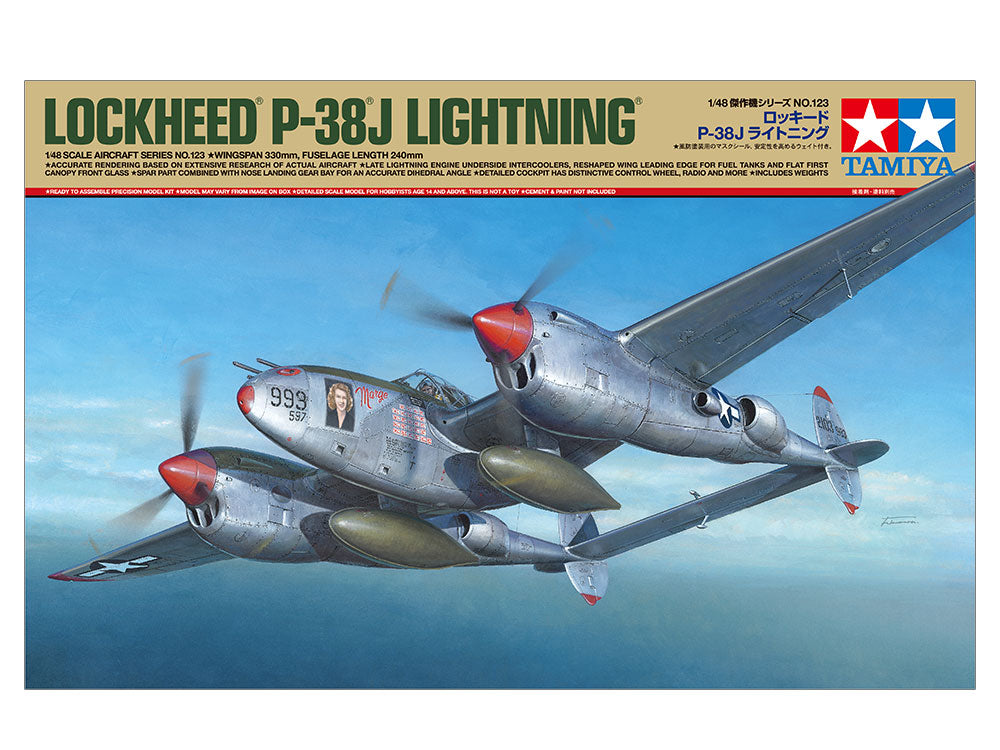
• 1/48 scale Lockheed P-38J Lightning plastic model kit by Tamiya (Kit No. 61123)
• Represents the legendary Lockheed P-38J Lightning, one of the most distinctive and successful American fighter aircraft of World War II
• Developed by Lockheed Aircraft Corporation for the United States Army Air Forces (USAAF)
• Famous for its unusual twin-boom configuration, central cockpit nacelle, twin engines and distinctive twin vertical stabilisers
• The P-38 Lightning first flew in January 1939 and entered operational service during World War II
• The P-38J variant entered production in 1943, incorporating important improvements over earlier Lightning models
• Designed as a high-performance interceptor, long-range escort fighter and multirole combat aircraft
• Widely operated in both the European and Pacific theatres during WWII
• Powered by two Allison V-1710 liquid-cooled V12 engines equipped with turbo-superchargers
• The P-38J's engines produced approximately 1,425 horsepower each at military power ratings
• Equipped with counter-rotating propellers, helping reduce the asymmetric handling characteristics associated with twin-engine aircraft
• Capable of reaching a maximum speed of approximately 660km/h (410mph) at altitude, depending on operating conditions
• The twin-engine configuration provided excellent performance and additional survivability during long-distance missions
• The Lightning's turbo-supercharged engines offered strong performance at high altitude
• Equipped with a distinctive tricycle landing gear arrangement, unusual among many WWII fighter aircraft
• Features a streamlined central cockpit nacelle positioned between the two engine booms
• Armed with one 20mm Hispano M2 cannon and four .50-calibre Browning machine guns concentrated in the aircraft's nose
• The nose-mounted armament eliminated the need for gun convergence associated with wing-mounted weapons
• This arrangement provided concentrated firepower and excellent accuracy during aerial combat
• The P-38 could also carry external bombs or auxiliary fuel tanks beneath its wings, depending on mission configuration
• The Lightning was particularly effective in long-range fighter escort and interception missions
• The P-38J introduced a revised intercooler arrangement, with enlarged air intakes beneath the engine nacelles
• These improvements helped address cooling limitations experienced by earlier Lightning variants
• Later P-38J production aircraft incorporated additional improvements to fuel systems, cockpit equipment and flight controls
• Some late-production P-38J aircraft were fitted with hydraulically boosted ailerons, improving roll control at higher speeds
• The P-38J became one of the most important Lightning variants used during the middle and later stages of WWII
• In the Pacific, the Lightning's exceptional range made it particularly valuable for operations across vast distances
• The P-38 was extensively used by the Fifth and Thirteenth Air Forces in the Southwest Pacific
• Lightning pilots frequently engaged Japanese fighters, bombers and reconnaissance aircraft
• The aircraft's speed, heavy armament and high-altitude performance made it a formidable opponent
• The P-38 was especially effective when pilots used high-speed attacks and energy-based combat tactics
• The Lightning was flown by several of America's most successful WWII fighter aces
• Major Richard I. Bong, America's highest-scoring WWII fighter ace with 40 confirmed aerial victories, flew the P-38 Lightning
• Major Thomas B. McGuire Jr., credited with 38 aerial victories, also achieved his successes flying the Lightning
• Both pilots became closely associated with the P-38's outstanding combat record in the Pacific
• The P-38 family also participated in the famous Operation Vengeance mission on 18 April 1943, which intercepted the aircraft carrying Japanese Admiral Isoroku Yamamoto
• This operation was conducted by earlier P-38 variants and demonstrated the Lightning's exceptional long-range interception capability
• In Europe, P-38 aircraft served as bomber escorts, fighter-bombers and tactical reconnaissance platforms
• The Lightning's distinctive silhouette earned it the German nickname Gabelschwanz-Teufel, commonly translated as Fork-Tailed Devil
• Its unusual twin-boom design remains one of the most recognisable aircraft configurations in aviation history
• The P-38 also formed the basis for specialised F-4 and F-5 photographic reconnaissance aircraft
• The Lightning's combination of range, speed and firepower made it one of the most versatile American combat aircraft of WWII
• More than 10,000 P-38 Lightning aircraft were produced across all variants
• The P-38J represents an important stage in the development of the Lightning before the introduction of the later P-38L
• The original aircraft measured approximately 11.53 metres in length with a wingspan of 15.85 metres
• At 1/48 scale, these dimensions translate to an approximate model length of 24cm and wingspan of 33cm
• 1/48 scale provides an impressive display size for showcasing the Lightning's distinctive twin-engine layout
• Ideal for collectors of WWII American fighter aircraft, Lockheed warbirds, USAAF aircraft and Pacific War aviation models
• Excellent companion to P-38F/G Lightning, P-38L Lightning, P-47 Thunderbolt, P-51 Mustang, P-39 Airacobra and other WWII American fighters
• Suitable for WWII Pacific airfield scenes, USAAF fighter squadron displays and European theatre aviation dioramas
• Offers excellent opportunities for recreating historically inspired USAAF Olive Drab and Neutral Grey camouflage schemes
• Many later P-38J aircraft also appeared in natural metal finishes, providing an alternative modelling challenge
• Suitable for historically researched Pacific theatre nose art, squadron markings and individual fighter ace aircraft, depending on the kit's decal options
• Ideal for realistic panel line washes, exhaust staining, oil streaks, paint fading and operational aircraft weathering
• The twin Allison engines and distinctive nacelle arrangement provide interesting opportunities for careful surface painting
• The large wing surfaces are excellent for practising airbrush camouflage, metallic finishes and subtle colour modulation
• The central cockpit nacelle and twin tail booms create a striking silhouette for display
• Suitable for creating a realistic WWII USAAF fighter airfield diorama with ground crew, maintenance equipment and support vehicles, available separately
• Particularly appealing to enthusiasts of American fighter aces, WWII aviation engineering, twin-engine fighters and historic Lockheed aircraft
• A standout addition to any collection of Tamiya aircraft models, WWII USAAF warbirds and 1/48 scale fighter aircraft
• Brand: Tamiya
• Kit Number: 61123
• Scale: 1/48
• Subject: Lockheed P-38J Lightning
• Aircraft Type: Twin-Engine Fighter / Fighter-Bomber
• Manufacturer of Original Aircraft: Lockheed Aircraft Corporation
• Operator: United States Army Air Forces (USAAF)
• Historical Period: World War II
• Engines: Two Allison V-1710 Turbo-Supercharged V12 Engines
• Primary Armament: One 20mm Cannon and Four .50-Calibre Machine Guns
• Country: United States
• Category: WWII Military Aircraft Plastic Model Kit
• Series: Tamiya 1/48 Aircraft Series
• Kit supplied unpainted and unassembled
• Glue and paint not included
• Recommended for modellers aged 14+